|
 Freedom and boundaries
|
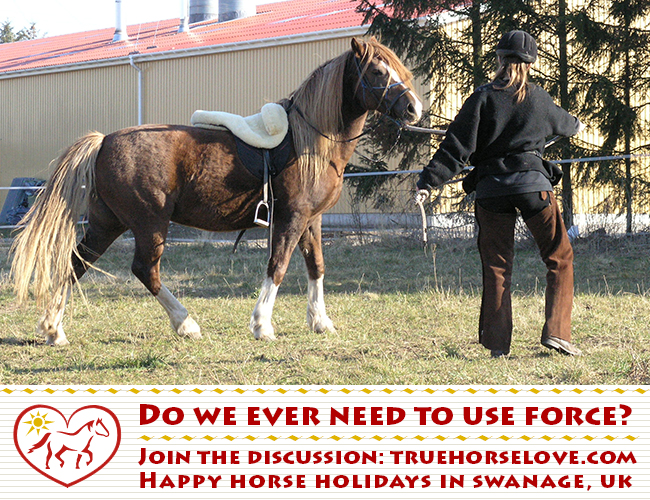 "Allow your horse the freedom to express its reactions to situations, at a safe distance". Now, if you are sitting on your horse, that is maybe not a safe distance. So, how do you solve this? I believe this is one of the reasons you should not ride your horse until you know it well from working with it from the ground. And the period of freedom to react is when your horse goes through many different reasons to react and deals with them one by one. So, when you can see that most of this learning has been accomplished, then, you start riding your horse in an environment and with a level of ambition that can safely allow space for reactions. What about the horses's reactions that are bound to occur when you are riding your horse? When situations occured in the past that upset my horse while I was sitting on it, I realised that just the fact that I was there with it, sitting on it, was reassuring for it, because it was used to it. I also found that if I chose to more or less ignore the 'danger' and the horse's upset, lean back, react slowly and gently, let go of the reins and maybe talk to it with a soft calm voice, there was hardly any reaction. It is always best to foresee situations that can cause reactions and act accordingly. Sometimes the best method is to get off the horse, so you can control the situation better and give your horse confidence with whatever is causing upset. I usually ride with my 6 meter long parelli rope as part of the kit in the first months when going out in new environments with a horse. What if the horse 'gets itself worked up' and it seems like bad behaviour that needs correcting? I found there is no bad behavior. There is always a reason; the wind, aching hoofs, belly ache, exhaustion, unfamiliar environment, sounds, visuals, smells and many other reasons, we cannot always see at first. No matter the reason, it's important to try and detect it and give yourself and the horse time to find the best way of dealing with it which will enforce your relationship and build trust. So, do you ever need to forcefully correct your horse? - A horse is a big animal and a basic part of working with it, is to teach it, to keep its distance and that humans are not horses and we cannot be bitten in the bum and wrestled with like other horses.
In the process of this teaching we need to demonstrate where the boundaries are which the horse must learn to respect. This is done using many varied means depending on level of patience, insight, trust in the horse and basic knowledge. As mentioned in many places on this website, it is not so much what you do, but how you do it. Actions taken with emphathy, balance and perfect timing normally work and improve the relationship between horse and human.
Some horse trainers, like Pat Parelli, introduce means that involve hitting the horse with a rope or in the head with a stick. Is this really necessary? Confronted with a herd of very loving and quite pushy 2 year old horses while I was stuck in deep mud, I found myself resorting to swinging the Parelli training rope and little faster, but did I have to?
I managed to control myself and realised that my perception of the situation, where I imagined I could fall under the horses, was not shared. The horses did not see my situation as an opportunity to take control, press my boundaries and they certainly had no desire to run me over. I realised that I could, just do as I normally do on a less challenging ground, communicate to each of them and ask for boundaries to be kept, and after a few repetitions they were.
How about the 2 year old mare, that thinks she is a queen and challenges me and pushes me with her shoulder on the stormy hill where I have an unstable foot hold? Again, I found that the way I could choose to interpret the situation; that she was a threat, was not beneficial to either of us. I chose to remain relaxed and I stood my ground, as always, and it was sufficiant.
So, do we ever need to be tough on our horses?
|